

中文版
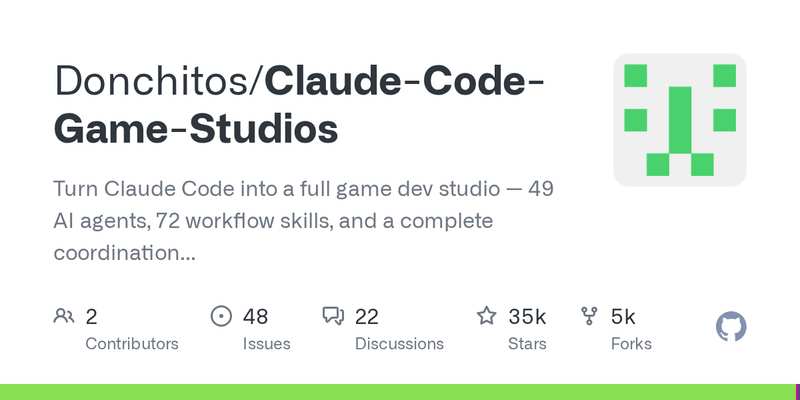
Claude-Code-Game-Studios(GitHub:https://github.com/Donchitos/Claude-Code-Game-Studios ,2026-02-12 创建,今晨抓取时已 34,666★)是把单个 Claude Code 会话变成一间完整游戏开发工作室的模板:49 个专业 agent、74 个技能、15 个 hooks、14 条规则、62 份文档模板,按真实工作室的层级组织起来。
按 README 的说法,单人用 AI 做游戏的问题不是“做不出来”,而是“没有结构”:没人拦你硬编码魔法数字、跳过设计文档、写面条代码,也没有 QA、设计评审和“这是否符合游戏愿景”的追问。这个模板用三层层级解决它:总监层(创意、技术、制作人)守愿景,部门负责人层(游戏设计、主程、美术、音频、叙事、QA 等)管领域,专家层(玩法、引擎、AI、网络、工具、UI 等)干具体活;引擎覆盖 Godot 4、Unity、Unreal Engine 5 三套专属 agent。工作流用斜杠命令驱动:/start 入门、/brainstorm 头脑风暴、/create-stories 拆故事、/dev-story 开发、/story-done 收尾,另有设计评审、代码评审、平衡检查、QA 计划、冒烟测试、发布清单等技能。最有意思的是它的“严谨度”开关(modes.rigor:minimal / standard / full):README 用实测提醒,standard 档在写第一行游戏代码前写了 30 份文档、耗时 58 分钟,而 blind 评审与真人试玩反而把 standard build 排在最后——多出来的文档换来的是可追溯性,不一定是更好的游戏;且任何改动玩家可见内容的故事,只有在游戏真正跑起来、被看过、截图存档后才算完成。
为什么值得了解
- 对想用 AI 做游戏的人,这是现成的“工作室组织架构”:你仍做每个决策,但有一支会提问、会 early 发现错误、会把项目从头到尾保持有序的队伍
- “严谨度可调”这个设计值得所有 agent 工作流借鉴:jam 速度与完整流程不是二选一,而是一个开关;默认 minimal 先跑出可玩的东西,项目长大再加流程
- 但要注意成本边界:三位总监要求 Opus 级模型、主程与 15 位专家指定 Sonnet,其余继承会话模型;重流程档会显著增加 token 消耗,先从 minimal 起手更划算
English Version
Claude-Code-Game-Studios (GitHub: https://github.com/Donchitos/Claude-Code-Game-Studios , created 2026-02-12, 34,666 stars at this morning’s fetch) is a template that turns a single Claude Code session into a full game development studio: 49 specialised agents, 74 skills, 15 hooks, 14 rules and 62 document templates, organised in the hierarchy of a real studio.
Per the README, the problem with solo AI game development is not “it cannot be built” but “it has no structure”: nothing stops you hardcoding magic numbers, skipping design documents or writing spaghetti code, and there is no QA pass, design review or voice asking “does this actually fit the game’s vision?” This template answers with three tiers: directors (creative, technical, producer) guard the vision, department leads (game design, lead programmer, art, audio, narrative, QA and more) own their domains, and specialists (gameplay, engine, AI, network, tools, UI and more) do the hands-on work; engine coverage spans Godot 4, Unity and Unreal Engine 5 specialist agent sets. Workflows run on slash commands: /start to begin, /brainstorm to explore ideas, /create-stories to break work down, /dev-story to build, /story-done to close, plus design review, code review, balance checks, QA plans, smoke tests and release checklists. Its most interesting design is the modes.rigor switch (minimal / standard / full): the README’s own measurement warns that the standard tier wrote 30 documents and spent 58 minutes before its first line of game code, yet blind reviewers and a human playtest ranked that build last — the extra documents bought traceability, not a better game; and a story that changes anything the player sees is not closed until the game has actually been launched, observed and screenshotted into evidence.
Why it’s worth knowing
- For anyone wanting to build games with AI, this is a ready-made “studio org chart”: you still make every decision, but now a team asks the right questions, catches mistakes early and keeps the project organised from first brainstorm to launch
- The adjustable-rigour design is worth borrowing for every agent workflow: jam speed and full process are not either/or but one switch — start at minimal to get something playable, then add process as the project grows
- Watch the cost boundary: the three directors ask for Opus-class models, the lead programmer and fifteen specialists name Sonnet, and the rest inherit your session’s model; the heavier tiers burn noticeably more tokens, so starting at minimal is the cheaper move

评论(0)
暂无评论